
Anxiety and Sleep: Why Your Mind Becomes More Active at Night
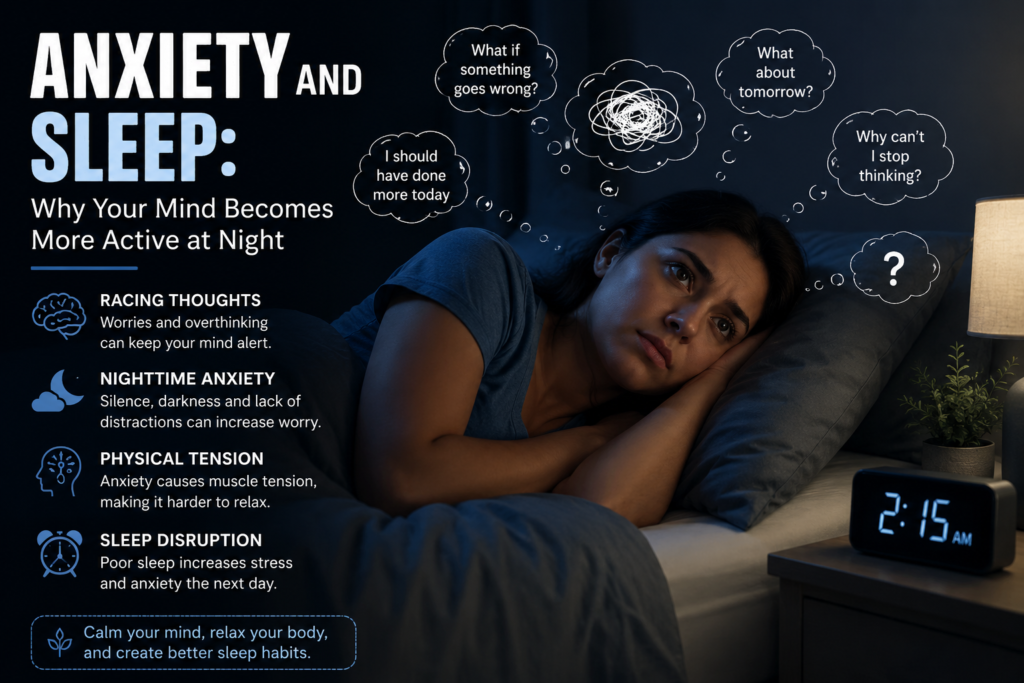
Have you ever spent an exhausting day waiting for bedtime, only to discover that your brain suddenly becomes wide awake the moment your head touches the pillow? You aren’t imagining it. For many people, nighttime creates the perfect environment for anxiety to become louder. During the day, work, conversations, errands, responsibilities, screens, and other distractions occupy attention. At night, those distractions disappear. The room becomes quiet—and thoughts that were pushed aside during the day can suddenly feel impossible to ignore. Anxiety and sleep can therefore become trapped in a frustrating cycle: Anxiety makes sleep difficult → poor sleep increases emotional sensitivity → increased stress makes anxiety stronger → bedtime becomes associated with worry → falling asleep becomes even harder. Understanding this cycle can make it easier to break. Medical disclaimer: This article is educational and isn’t a diagnosis or substitute for individualized medical advice. Persistent insomnia, severe anxiety, depression, or significant daytime impairment should be discussed with a qualified healthcare professional. What Is Nighttime Anxiety? Nighttime anxiety isn’t necessarily a separate medical diagnosis. Rather, it describes anxiety symptoms that become particularly noticeable when you’re trying to sleep or when you wake during the night. You might experience: Racing thoughts Repeatedly replaying conversations Worrying about tomorrow Muscle tension A pounding or noticeable heartbeat Restlessness Difficulty relaxing Fear that you won’t sleep Repeatedly checking the clock Feeling physically tired but mentally alert Anxiety disorders themselves can include difficulty falling asleep or staying asleep, along with fatigue and difficulty concentrating. For some people, the problem begins with ordinary stress. For others, persistent nighttime worry can be part of generalized anxiety disorder, panic disorder, depression, or another condition. National Institute of Mental Health – Anxiety Disorders Why Does Your Brain Become More Active at Night? 1. Daytime distractions disappear During the day, your attention is constantly being redirected. You might spend eight hours working, answering messages, commuting, talking to people, shopping, exercising, or taking care of family responsibilities. When nighttime arrives, those activities stop. Suddenly, there’s space for thoughts that you’ve been postponing. Your brain may essentially say: “Now that everything is quiet, let’s think about everything we didn’t have time to think about today.” This can make nighttime anxiety feel much stronger even though the underlying stress hasn’t necessarily changed. 2. Your brain starts reviewing the day Have you ever replayed a conversation from hours earlier and suddenly wondered: “Why did I say that?” An anxious mind can become particularly focused on uncertainty. You might replay: Something you said at work A disagreement A financial concern A medical symptom A relationship problem Something you forgot to accomplish An upcoming appointment A decision you haven’t made Instead of reaching a conclusion, the brain can keep generating additional questions. That’s where rumination can enter the picture. The goal feels like problem-solving, but the result may simply be more worry. The “What If?” Machine Anxiety often thrives on hypothetical situations. At night, thoughts may progress like this: What if I make a mistake tomorrow? becomes: What if my boss notices? then: What if I lose my job? then: What if I can’t pay my bills? A single thought can turn into an entire imagined future. The problem isn’t that thinking about the future is inherently bad. Planning is useful. The problem occurs when the brain repeatedly searches for certainty about things that cannot be completely controlled. NIMH describes excessive, difficult-to-control worry as a central feature of generalized anxiety disorder. Why Worrying About Sleep Can Make Sleep Worse This is one of the most frustrating parts of insomnia. You look at the clock: 11:45 p.m. Then: 12:30 a.m. Then: 1:15 a.m. Now you’re no longer simply trying to sleep. You’re calculating how many hours remain before morning. That creates another layer of anxiety: “If I don’t fall asleep right now, tomorrow will be terrible.” The pressure to sleep can paradoxically make relaxation more difficult. NHLBI notes that worrying about whether you’ll get enough sleep and watching the clock can increase the risk of insomnia or make it worse. In other words, sleep can become a performance test. And sleep doesn’t respond particularly well to pressure. Anxiety, Muscle Tension and Sleep Anxiety isn’t only mental. It can also show up physically. You might unconsciously tighten your: Jaw Neck Shoulders Back Forehead Hands By bedtime, your body may be exhausted while remaining physically tense. NIMH lists muscle tension, headaches, body aches, restlessness, and sleep problems among symptoms associated with generalized anxiety disorder. This can create another loop: Anxiety → muscle tension → discomfort → difficulty relaxing → poor sleep → greater sensitivity to stress the next day. Learning relaxation techniques can therefore be useful as part of a broader anxiety and sleep strategy. How Poor Sleep Can Affect Anxiety the Next Day The relationship works in both directions. Anxiety can interfere with sleep, but insufficient or poor-quality sleep can also leave you feeling more irritable, emotionally sensitive, tired, and unable to concentrate. Insomnia can involve difficulty falling asleep, staying asleep, or waking too early. Poor-quality sleep can also contribute to daytime sleepiness and concentration problems. This creates a dangerous mental shortcut: “I slept badly, so tomorrow is going to be awful.” That prediction itself can increase anxiety. Instead, try a more balanced thought: “I may be tired tomorrow, but I can still get through the day.” That doesn’t guarantee perfect sleep. It simply removes some of the pressure surrounding it. Anxiety, Depression and Sleep: Why They Often Travel Together Sleep problems don’t always occur in isolation. Anxiety and depression can both affect sleep, and persistent sleep problems can make emotional health more difficult to manage. Someone experiencing depression might sleep too little, wake frequently, or sometimes sleep excessively. Someone experiencing anxiety may struggle primarily with falling asleep because their mind remains highly active. This is why simply treating “the sleep problem” may not always address the underlying issue. If anxiety or depression is driving persistent insomnia, evaluating the underlying condition is important. NIMH – Depression Information 7 Practical