
The Anxiety–Muscle Tension–Pain Cycle: Understanding the Connection
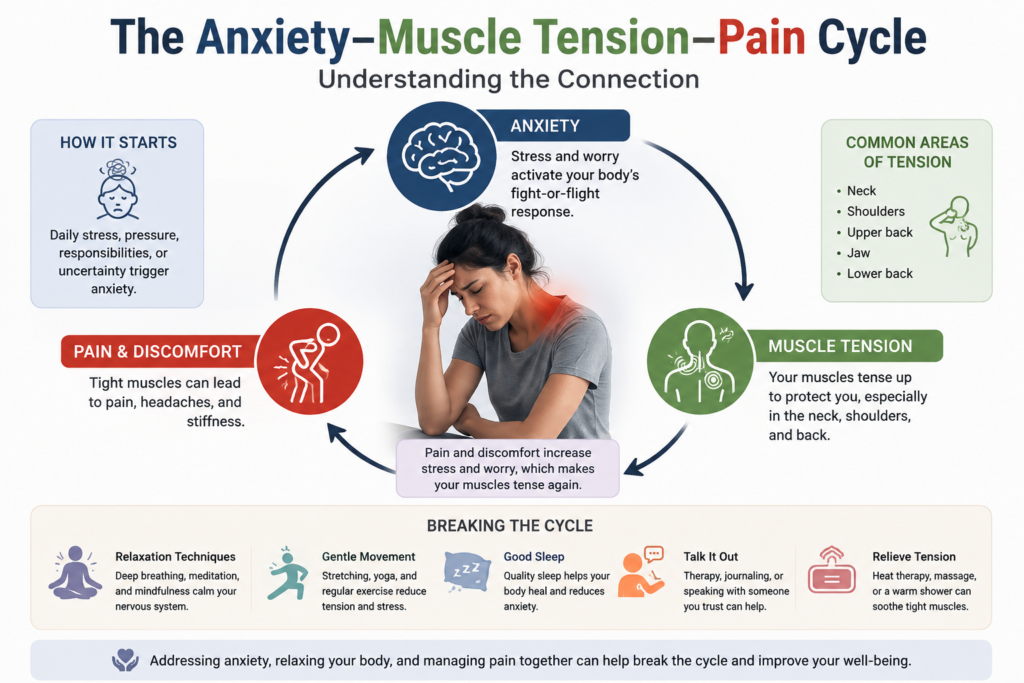
Introduction: The Hidden Loop That Controls Your Well-Being Have you ever noticed how your shoulders seem to creep up toward your ears during a stressful meeting? Or how your jaw tightens when you’re worried about something? Perhaps you’ve woken up with a tension headache after a particularly anxious week, or felt that familiar knot in your neck that just won’t go away. These aren’t random occurrences. They’re all part of a powerful, self-perpetuating cycle that affects millions of people worldwide: the anxiety–muscle tension–pain cycle. This complex interplay between your mental state, physical body, and nervous system can turn everyday stress into chronic pain, and chronic pain into more anxiety, creating a loop that feels impossible to escape. But here’s the empowering truth: once you understand how this cycle works, you gain the power to break it. This comprehensive guide will walk you through every aspect of the anxiety–muscle tension–pain connection, from the underlying biology to practical, actionable strategies that can help you find relief. For those seeking additional support, Global Health Martz offers a range of resources and products designed to help manage both pain and anxiety symptoms. Part 1: Understanding the Cycle What Exactly Is the Anxiety–Muscle Tension–Pain Cycle? The anxiety–muscle tension–pain cycle is a bidirectional feedback loop where: Anxiety triggers physical tension in the body Muscle tension leads to pain and discomfort Pain reinforces and amplifies anxiety Increased anxiety creates more tension… and the cycle continues This isn’t just in your head — it’s a very real physiological response that involves your nervous system, endocrine system, and musculoskeletal system working together (or rather, working against you). The Biology Behind the Loop When you experience anxiety, your body’s sympathetic nervous system activates the famous “fight-or-flight” response. This evolutionary mechanism, designed to protect you from immediate threats, triggers a cascade of physiological changes: Stress hormones surge — Cortisol and adrenaline flood your system Heart rate increases — Blood pumps faster to vital organs Breathing becomes shallow — Oxygen intake changes Muscles contract — Your body prepares to fight or flee In short-term, acute situations, this response is adaptive and even life-saving. But when anxiety becomes chronic — when your nervous system stays in this heightened state day after day — the constant muscle contraction becomes problematic. The National Institute of Mental Health provides excellent resources on how chronic stress affects the body, while the Anxiety and Depression Association of America offers additional insights into the physical symptoms of anxiety disorders. How Chronic Tension Develops When muscles remain partially contracted for extended periods, several things happen: 1. Trigger Points Form These are hyperirritable knots in muscle tissue that can refer pain to other areas of the body. A trigger point in your shoulder might cause pain in your neck, head, or even down your arm. 2. Blood Flow Decreases Tight muscles compress blood vessels, reducing oxygen and nutrient delivery to tissues. At the same time, metabolic waste products accumulate, creating an environment conducive to pain and inflammation. 3. Nervous System Sensitisation Prolonged pain signals actually change how your nervous system processes information. Your brain becomes more reactive to pain signals, meaning you feel pain more intensely and from stimuli that wouldn’t normally hurt. 4. Postural Changes Chronic tension pulls your body out of alignment. Forward head posture, rounded shoulders, and a tilted pelvis all become habitual, creating additional strain on muscles and joints. The Pain-Anxiety Feedback Loop The physical discomfort created by chronic tension then feeds back into your mind: Pain is distracting — It’s hard to focus on anything else when you’re hurting Pain is worrying — You might fear that something is seriously wrong Pain is exhausting — Constant discomfort drains your energy and emotional reserves Pain reinforces anxiety — The belief that “something is wrong” fuels more worry This creates a perfect storm where physical symptoms and psychological distress reinforce each other, making both worse over time. For those experiencing moderate to severe pain, exploring pain relief support options can provide additional context on managing physical symptoms alongside psychological interventions. Part 2: Common Tension Areas and Their Impact Where Stress Lives in Your Body While anxiety can cause tension anywhere in the body, certain areas are particularly susceptible: 1. The Neck and Shoulders Perhaps the most common site of stress-related tension, the neck and shoulders bear the brunt of our modern lifestyle. Hours spent hunched over screens, combined with the physical response to stress, create a perfect recipe for chronic tightness. This tension can lead to: Tension headaches Reduced range of motion Pain radiating down the arms Dizziness and balance issues 2. The Jaw (Temporomandibular Joint) Many people unconsciously clench their jaw or grind their teeth when stressed — sometimes even during sleep. This can cause: Jaw pain and stiffness Headaches (especially in the temples) Earaches Difficulty chewing Clicking or popping sounds when opening the mouth 3. The Lower Back The lumbar spine is particularly vulnerable to stress-induced tension. When you’re anxious, you may unconsciously tense your back muscles, leading to: Chronic lower back pain Reduced flexibility Sciatica symptoms Difficulty standing or sitting for long periods 4. The Temples and Forehead Stress often manifests as tension headaches that start in the temples or across the forehead. These headaches can feel like a tight band around your head and are often accompanied by: Sensitivity to light and sound Scalp tenderness Difficulty concentrating 5. The Hips and Pelvis The hip flexors and pelvic floor muscles are also common sites of stress-related tension. This can manifest as: Hip pain and stiffness Lower back pain Pelvic pain Digestive issues The Mayo Clinic offers comprehensive information on chronic pain conditions, while Global Health Martz provides access to various products that may help manage these symptoms. Part 3: Breaking the Cycle — Comprehensive Strategies Because the cycle operates in both directions, you have multiple points of intervention. Here’s a complete toolkit for breaking free. Strategy 1: Somatic Release Techniques Progressive Muscle Relaxation (PMR) This evidence-based technique involves systematically tensing and then relaxing different muscle groups in your body. Here’s how to do it: Find a comfortable position lying down or sitting Start with your feet — tense the muscles for