
Introduction: The Hidden Loop That Controls Your Well-Being
Have you ever noticed how your shoulders seem to creep up toward your ears during a stressful meeting? Or how your jaw tightens when you’re worried about something? Perhaps you’ve woken up with a tension headache after a particularly anxious week, or felt that familiar knot in your neck that just won’t go away.
These aren’t random occurrences. They’re all part of a powerful, self-perpetuating cycle that affects millions of people worldwide: the anxiety–muscle tension–pain cycle. This complex interplay between your mental state, physical body, and nervous system can turn everyday stress into chronic pain, and chronic pain into more anxiety, creating a loop that feels impossible to escape.
But here’s the empowering truth: once you understand how this cycle works, you gain the power to break it. This comprehensive guide will walk you through every aspect of the anxiety–muscle tension–pain connection, from the underlying biology to practical, actionable strategies that can help you find relief.
For those seeking additional support, Global Health Martz offers a range of resources and products designed to help manage both pain and anxiety symptoms.
Part 1: Understanding the Cycle
What Exactly Is the Anxiety–Muscle Tension–Pain Cycle?
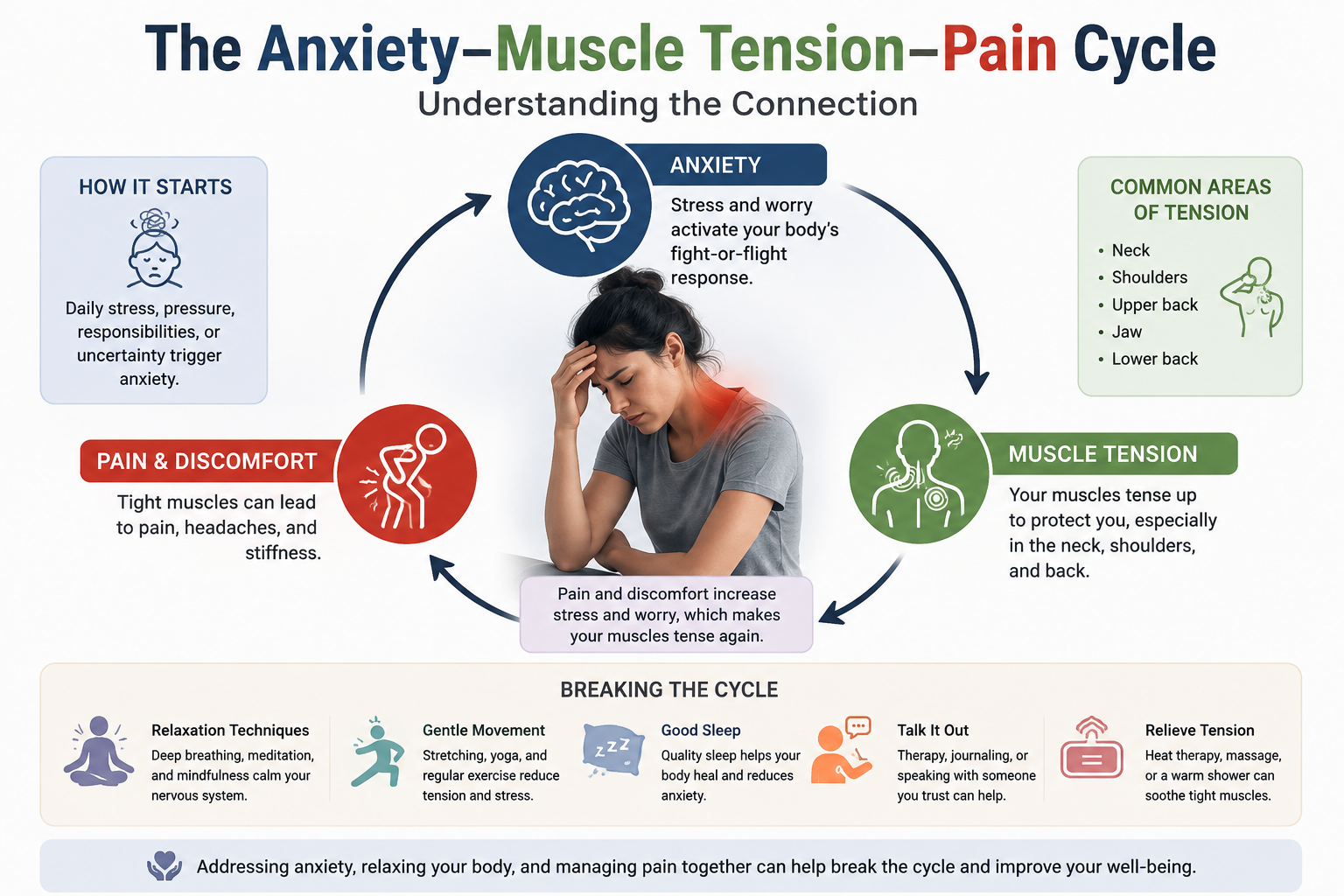
The anxiety–muscle tension–pain cycle is a bidirectional feedback loop where:
-
Anxiety triggers physical tension in the body
-
Muscle tension leads to pain and discomfort
-
Pain reinforces and amplifies anxiety
-
Increased anxiety creates more tension… and the cycle continues
This isn’t just in your head — it’s a very real physiological response that involves your nervous system, endocrine system, and musculoskeletal system working together (or rather, working against you).
The Biology Behind the Loop
When you experience anxiety, your body’s sympathetic nervous system activates the famous “fight-or-flight” response. This evolutionary mechanism, designed to protect you from immediate threats, triggers a cascade of physiological changes:
-
Stress hormones surge — Cortisol and adrenaline flood your system
-
Heart rate increases — Blood pumps faster to vital organs
-
Breathing becomes shallow — Oxygen intake changes
-
Muscles contract — Your body prepares to fight or flee
In short-term, acute situations, this response is adaptive and even life-saving. But when anxiety becomes chronic — when your nervous system stays in this heightened state day after day — the constant muscle contraction becomes problematic.
The National Institute of Mental Health provides excellent resources on how chronic stress affects the body, while the Anxiety and Depression Association of America offers additional insights into the physical symptoms of anxiety disorders.
How Chronic Tension Develops
When muscles remain partially contracted for extended periods, several things happen:
1. Trigger Points Form
These are hyperirritable knots in muscle tissue that can refer pain to other areas of the body. A trigger point in your shoulder might cause pain in your neck, head, or even down your arm.
2. Blood Flow Decreases
Tight muscles compress blood vessels, reducing oxygen and nutrient delivery to tissues. At the same time, metabolic waste products accumulate, creating an environment conducive to pain and inflammation.
3. Nervous System Sensitisation
Prolonged pain signals actually change how your nervous system processes information. Your brain becomes more reactive to pain signals, meaning you feel pain more intensely and from stimuli that wouldn’t normally hurt.
4. Postural Changes
Chronic tension pulls your body out of alignment. Forward head posture, rounded shoulders, and a tilted pelvis all become habitual, creating additional strain on muscles and joints.
The Pain-Anxiety Feedback Loop
The physical discomfort created by chronic tension then feeds back into your mind:
-
Pain is distracting — It’s hard to focus on anything else when you’re hurting
-
Pain is worrying — You might fear that something is seriously wrong
-
Pain is exhausting — Constant discomfort drains your energy and emotional reserves
-
Pain reinforces anxiety — The belief that “something is wrong” fuels more worry
This creates a perfect storm where physical symptoms and psychological distress reinforce each other, making both worse over time.
For those experiencing moderate to severe pain, exploring pain relief support options can provide additional context on managing physical symptoms alongside psychological interventions.
Part 2: Common Tension Areas and Their Impact
Where Stress Lives in Your Body
While anxiety can cause tension anywhere in the body, certain areas are particularly susceptible:
1. The Neck and Shoulders
Perhaps the most common site of stress-related tension, the neck and shoulders bear the brunt of our modern lifestyle. Hours spent hunched over screens, combined with the physical response to stress, create a perfect recipe for chronic tightness. This tension can lead to:
-
Tension headaches
-
Reduced range of motion
-
Pain radiating down the arms
-
Dizziness and balance issues
2. The Jaw (Temporomandibular Joint)
Many people unconsciously clench their jaw or grind their teeth when stressed — sometimes even during sleep. This can cause:
-
Jaw pain and stiffness
-
Headaches (especially in the temples)
-
Earaches
-
Difficulty chewing
-
Clicking or popping sounds when opening the mouth
3. The Lower Back
The lumbar spine is particularly vulnerable to stress-induced tension. When you’re anxious, you may unconsciously tense your back muscles, leading to:
-
Chronic lower back pain
-
Reduced flexibility
-
Sciatica symptoms
-
Difficulty standing or sitting for long periods
4. The Temples and Forehead
Stress often manifests as tension headaches that start in the temples or across the forehead. These headaches can feel like a tight band around your head and are often accompanied by:
-
Sensitivity to light and sound
-
Scalp tenderness
-
Difficulty concentrating
5. The Hips and Pelvis
The hip flexors and pelvic floor muscles are also common sites of stress-related tension. This can manifest as:
-
Hip pain and stiffness
-
Lower back pain
-
Pelvic pain
-
Digestive issues
The Mayo Clinic offers comprehensive information on chronic pain conditions, while Global Health Martz provides access to various products that may help manage these symptoms.
Part 3: Breaking the Cycle — Comprehensive Strategies
Because the cycle operates in both directions, you have multiple points of intervention. Here’s a complete toolkit for breaking free.
Strategy 1: Somatic Release Techniques
Progressive Muscle Relaxation (PMR)
This evidence-based technique involves systematically tensing and then relaxing different muscle groups in your body. Here’s how to do it:
-
Find a comfortable position lying down or sitting
-
Start with your feet — tense the muscles for 5 seconds, then release for 10 seconds
-
Move up to your calves, thighs, buttocks, abdomen, chest, hands, arms, shoulders, neck, and face
-
With each release, notice the sensation of relaxation spreading through that area
Practice PMR daily for 10-15 minutes, and you’ll become more aware of tension in your body and better able to release it.
Diaphragmatic Breathing (Belly Breathing)
Shallow chest breathing is common during anxiety and actually maintains the stress response. Deep diaphragmatic breathing activates the parasympathetic nervous system — the “rest and digest” system — helping to counteract the stress response.
Try this technique:
-
Place one hand on your chest and one on your belly
-
Breathe in slowly through your nose for 4 counts, feeling your belly rise
-
Hold for 2 counts
-
Exhale slowly through your mouth for 6 counts, feeling your belly fall
-
Repeat for 5-10 minutes
Gentle Stretching
Incorporate gentle stretching into your daily routine, focusing on areas where you hold tension:
-
Neck stretches — Gently tilt your head to each side, and forward and back
-
Shoulder rolls — Roll your shoulders forward and backward in circles
-
Chest openers — Clasp your hands behind your back and gently lift
-
Cat-cow stretch — On hands and knees, alternate arching and rounding your back
-
Hamstring stretches — While sitting, extend one leg and gently reach toward your toes
The American Psychological Association provides research-backed techniques for stress reduction that complement these physical approaches.
Strategy 2: Cognitive Approaches
Cognitive-Behavioral Techniques (CBT)
CBT helps you identify and challenge unhelpful thought patterns that amplify anxiety and pain. Key techniques include:
Cognitive Restructuring:
-
Identify the automatic thought (e.g., “This pain means I’m seriously ill”)
-
Challenge the thought (e.g., “Is there evidence for this? What are alternative explanations?”)
-
Replace with a more balanced thought (e.g., “This pain is likely from muscle tension, which is common and treatable”)
Mindfulness Meditation
Mindfulness involves paying attention to the present moment without judgment. This can be particularly helpful for pain and anxiety because it:
-
Reduces rumination and worry
-
Changes your relationship with pain
-
Decreases stress hormone levels
-
Increases acceptance and reduces suffering
Start with just 5 minutes daily, focusing on your breath and noticing thoughts without getting caught up in them.
Acceptance and Commitment Therapy (ACT)
ACT encourages you to accept what’s outside your control while committing to actions that align with your values. For chronic pain and anxiety, this means:
-
Acknowledging pain without fighting it
-
Making space for difficult emotions
-
Focusing on what you can control
-
Taking action toward meaningful goals
For those interested in exploring medication as part of their anxiety management plan, anxiety management resources are available through Global Health Martz.
Strategy 3: Physical Approaches
Low-Impact Exercise
Physical activity is one of the most effective interventions for both anxiety and pain. Options include:
-
Walking — Start with 15-20 minutes daily and gradually increase
-
Swimming — The water supports your body while providing resistance
-
Yoga — Combines movement, stretching, and breath work
-
Tai Chi — Gentle, flowing movements that reduce stress and improve balance
-
Cycling — Low-impact and can be done indoors or out
Posture Correction
Poor posture significantly contributes to muscle tension. Follow these principles:
-
Keep your head level — imagine a string pulling you up from the top of your head
-
Align your ears over your shoulders
-
Keep your shoulders back and down
-
Maintain a neutral spine — not too arched or rounded
-
When sitting, keep your feet flat on the floor and your knees at hip level
Ergonomic Adjustments
Make these changes to reduce daily tension:
-
Adjust your computer monitor to eye level
-
Use a chair with good lumbar support
-
Take regular breaks to stand and move (every 30-45 minutes)
-
Use a headset for phone calls to avoid cradling the phone with your shoulder
The Centers for Disease Control and Prevention offers excellent guidelines on incorporating physical activity into your routine.
Strategy 4: Lifestyle Interventions
Sleep Optimization
Poor sleep worsens both anxiety and pain. Improve your sleep with these strategies:
-
Stick to a consistent sleep schedule, even on weekends
-
Create a relaxing bedtime routine (reading, gentle stretching, warm bath)
-
Keep your bedroom cool, dark, and quiet
-
Avoid screens for at least an hour before bed
-
Limit caffeine and alcohol, especially in the evening
-
Don’t lie in bed awake — get up and do something calming until you feel sleepy
Nutrition and Hydration
What you eat affects both your physical and mental health:
-
Stay hydrated — dehydration can worsen both pain and anxiety
-
Eat regular, balanced meals to maintain stable blood sugar
-
Include anti-inflammatory foods (fatty fish, leafy greens, berries, nuts)
-
Limit processed foods, sugar, and refined carbohydrates
-
Consider magnesium-rich foods (spinach, pumpkin seeds, dark chocolate) for muscle relaxation
Social Connection
Isolation worsens both anxiety and pain. Prioritise connection:
-
Reach out to friends and family regularly
-
Join a support group (in-person or online)
-
Consider therapy or counselling
-
Even brief social interactions can help regulate your nervous system
For those who may benefit from additional calming support, explore calming options that can be discussed with a healthcare provider.
Part 4: What the Research Reveals
Scientific Evidence for the Anxiety-Pain Connection
The link between anxiety and chronic pain is well-documented in scientific literature. Here are some key findings:
Prevalence and Association
-
Individuals with anxiety disorders are 2.5-3 times more likely to report chronic pain conditions
-
Up to 65% of patients with chronic pain also meet criteria for a mental health condition
-
Tension-type headaches are the most common form of headache, affecting up to 78% of the general population
Mechanisms
-
Central sensitisation explains how anxiety lowers the pain threshold
-
Altered pain modulation in the brainstem is observed in both anxiety and chronic pain
-
Neuroplastic changes in the brain occur with both conditions
Treatment Outcomes
-
Combination treatment (psychotherapy + physical therapy) shows the best outcomes
-
Mindfulness-based stress reduction (MBSR) shows significant benefits for both
-
Cognitive-behavioural therapy (CBT) specifically targeting pain and anxiety is more effective than either approach alone
Promising Interventions
Several specific interventions have shown strong evidence:
Mindfulness-Based Stress Reduction (MBSR)
This 8-week program combines mindfulness meditation and yoga. Studies show:
-
Reduced anxiety and depression
-
Decreased pain intensity and interference
-
Improved physical functioning
-
Enhanced overall quality of life
Acceptance and Commitment Therapy (ACT)
ACT for chronic pain shows:
-
Reduced pain-related distress
-
Increased psychological flexibility
-
Improved functioning despite pain
-
Reduced medication use
Physical Therapy with Myofascial Release
Combining physical therapy with targeted myofascial release techniques:
-
Reduces trigger point activity
-
Decreases pain intensity
-
Lower anxiety scores
-
Improves range of motion
The National Center for Complementary and Integrative Health provides research-backed information on complementary approaches to pain and anxiety management.
Part 5: Your Comprehensive Action Plan
Step 1: Awareness and Assessment
Before you can change something, you need to be aware of it. Start by:
-
Keep a symptoms journal — Track when you notice tension, what you were doing, and how you were feeling emotionally
-
Identify patterns — Does tension spike at certain times of day? During specific activities? After particular emotional triggers?
-
Rate your pain and anxiety — Use a 1-10 scale to track severity over time
-
Notice early warning signs — What subtle signals tell you that tension or anxiety is building?
Step 2: Daily Prevention Practices
These small practices can prevent tension from accumulating:
Every Morning:
-
2 minutes of diaphragmatic breathing
-
5 minutes of gentle stretching
-
Set an intention for the day (e.g., “I will notice and release tension”)
Throughout the Day:
-
Set a timer to check in with your body every hour (posture check + deep breath)
-
Take movement breaks (stand, stretch, walk) every 30-45 minutes
-
Stay hydrated and eat regular, balanced meals
-
If you notice tension rising, take 30 seconds for the “3-breath reset”
Evening Wind-Down:
-
10 minutes of progressive muscle relaxation
-
Gentle stretching before bed
-
Limit screen time in the hour before sleep
-
Practice gratitude journaling
Step 3: Responding to Acute Episodes
When tension or pain spikes, try these immediate strategies:
-
Pause and breathe — Take 5 deep, slow breaths
-
Scan your body — Notice where you’re holding tension and consciously relax those areas
-
Change position — Stand, stretch, or take a brief walk
-
Apply heat or cold — Heat relaxes muscles; cold reduces inflammation
-
Use gentle self-massage — Press on tight spots with your fingertips
-
Reframe catastrophic thoughts — Remind yourself this is temporary and manageable
-
Reach out — Even a brief phone call to a supportive person can help
For personalized medication options to manage severe symptoms, Global Health Martz offers a variety of products that may be suitable for your needs.
Part 6: When to Seek Professional Help
While self-care strategies are powerful, there are times when professional help is needed:
Signs You Should Consult a Professional
-
Pain persists for more than 3-4 weeks
-
Pain interferes significantly with daily activities
-
You’re experiencing depression or significant anxiety
-
Self-care strategies aren’t providing adequate relief
-
You’re having trouble sleeping or functioning
-
You’re considering medication
Types of Professionals Who Can Help
Primary Care Physician:
-
Rule out underlying medical conditions
-
Provide referrals to specialists
-
Prescribe medication if appropriate
Mental Health Professional (Psychologist or Psychiatrist):
-
Provide cognitive-behavioural therapy
-
Treat co-occurring anxiety or depression
-
Monitor medication if prescribed
Physical Therapist:
-
Assess and treat musculoskeletal issues
-
Develop a personalised exercise program
-
Use manual therapy techniques
Massage Therapist:
-
Release muscle tension and trigger points
-
Provide education on self-care techniques
-
Offer regular maintenance sessions
Occupational Therapist:
-
Help you adapt activities to reduce strain
-
Provide ergonomic recommendations
-
Teach energy conservation techniques
Medication Options
ome, medication can be a helpful part of a comprehensive treatment plan:
For Pain:
-
Non-steroidal anti-inflammatory drugs (NSAIDs)
-
Muscle relaxants
-
Antidepressants (certain types also help with pain)
-
Anticonvulsants (effective for nerve pain)
For Anxiety:
-
Selective serotonin reuptake inhibitors (SSRIs)
-
Serotonin-norepinephrine reuptake inhibitors (SNRIs)
-
Benzodiazepines (for short-term use)
-
Buspirone
Always work with a healthcare provider to determine the appropriate medications for your situation, and be aware of potential side effects and interactions.
Global Health Martz offers a range of products including Tramadol for pain relief and Alprazolam for anxiety management , but these should always be used under medical supervision.
Part 7: Maintaining Progress and Long-Term Wellness
Building Resilience
Over time, you can build your capacity to handle stress and maintain physical comfort:
-
Regular practice — Consistency is more important than intensity. Make your chosen practices part of your daily routine.
-
Gradual progression — Slowly increase the duration or intensity of your practices as they become more comfortable.
-
Celebrate small wins — Notice and acknowledge every improvement, no matter how small.
-
Learn from setbacks — Expect occasional setbacks and view them as learning opportunities, not failures.
-
Create a supportive environment — Surround yourself with people who understand and support your health goals.
Preventing Relapse
As you progress, maintain your gains with these strategies:
-
Continue daily prevention practices
-
Schedule regular check-ins with your body
-
Plan for stressful periods (e.g., holidays, work deadlines)
-
Maintain connections with healthcare providers
-
Keep a maintenance exercise routine
The Path Forward
Remember that healing is rarely linear. There will be good days and challenging days. The goal isn’t perfection — it’s progress. Each time you notice tension, take a breath, or choose a healthier response, you’re weakening the cycle and strengthening your resilience.
Conclusion: You Have More Power Than You Think
The anxiety–muscle tension–pain cycle can feel overwhelming, especially when you’ve been caught in it for a long time. But here’s the important truth: this cycle is not permanent, and you have more power to influence it than you might believe.
By understanding the connection between your thoughts, your nervous system, and your physical body, you’ve already taken the first and most important step. Every time you:
-
Notice tension in your body and consciously relax it
-
Take a deep breath rather than reacting automatically
-
Challenge an anxious thought rather than accepting it as truth
-
Move your body rather than staying frozen in stress
…you’re breaking the cycle.
Start with one small practice today. It could be the 3-breath reset, a gentle neck stretch, or simply noticing when your shoulders are creeping up toward your ears. Build from there, gradually adding more strategies as you become comfortable.
With patience, consistency, and self-compassion, you can transform your relationship with stress, tension, and pain. Your body and mind are not enemies working against you — they’re partners in your wellbeing, and with the right understanding and practices, you can guide them back into harmony.
For those who need additional support, Global Health Martz provides a comprehensive range of resources, including pain relief and anxiety management options to complement your wellness journey.