
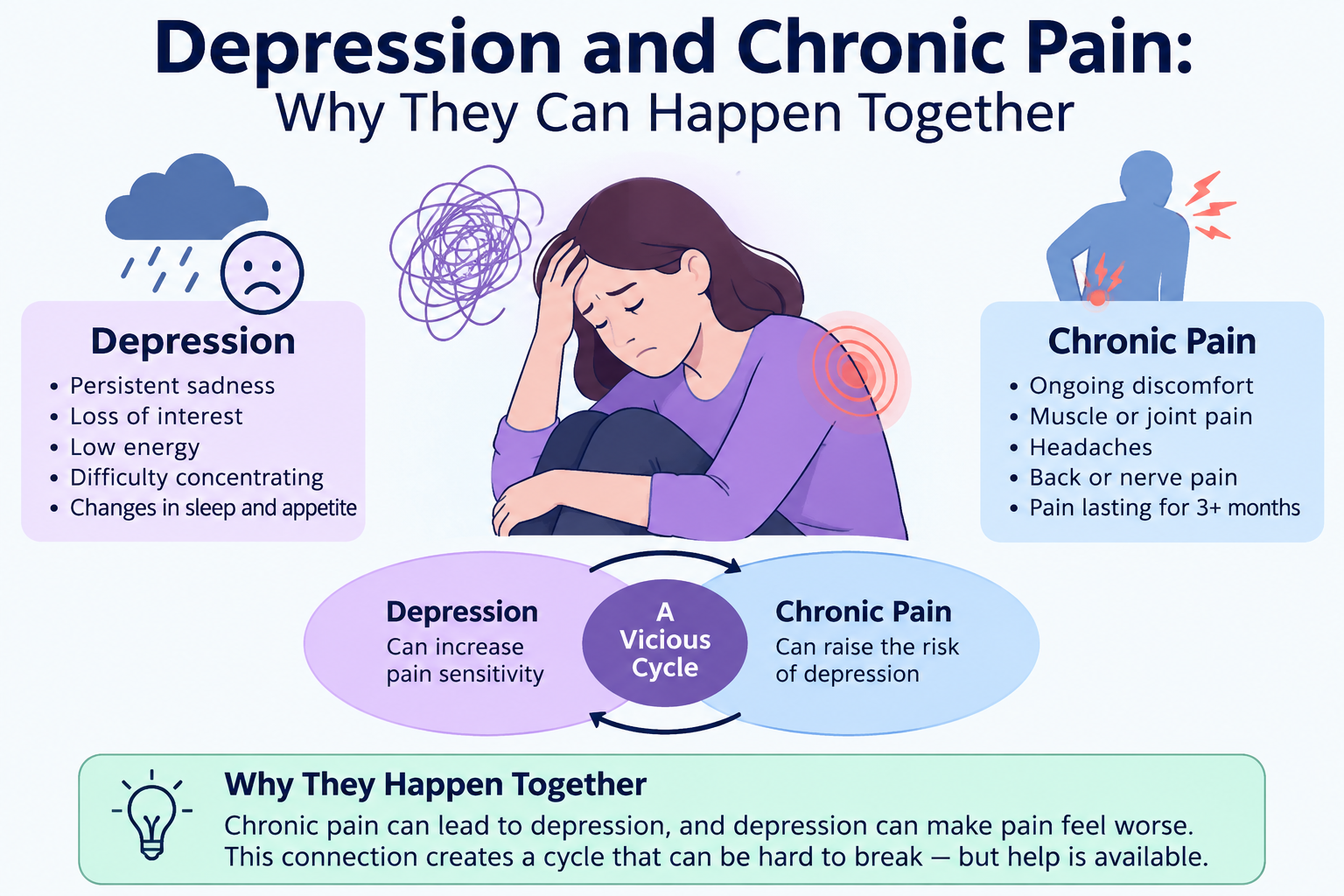
Depression is often described as an emotional condition, but its effects aren’t limited to mood.
For some people, depression can come with muscle aches, body pain, fatigue, headaches, sleep problems, and physical tension. At the same time, living with persistent muscle or body pain can affect mood and increase the risk of depression.
This creates a complicated relationship between the mind and body.
According to the National Institute of Mental Health (NIMH), depression can occur alongside chronic pain and other chronic illnesses, and each condition can make the other more difficult to manage.
So, can depression cause muscle pain?
It can contribute to physical aches and pain in some people, but unexplained or persistent muscle pain shouldn’t automatically be blamed on depression. There can be many physical causes that require medical evaluation.
Can Depression Cause Muscle Pain?
Yes, depression can be associated with physical pain, including muscle aches and generalized body discomfort.
The relationship isn’t as simple as saying that depression directly damages muscles. Instead, depression can affect several systems involved in how the body experiences pain.
NIMH lists physical aches or pains, headaches, cramps, and digestive problems among possible symptoms of depression, particularly when they persist without a clear physical explanation.
This is one reason someone experiencing depression might say:
“I don’t just feel emotionally exhausted. My whole body hurts.”
The physical symptoms are real, even when a conventional injury isn’t responsible.
Why Does Depression Sometimes Make Your Muscles Hurt?
Several factors can overlap.
1. Muscle tension
Stress and emotional distress can produce physical tension.
You may unconsciously tighten your shoulders, jaw, neck, back, or other muscles when you’re worried or emotionally overwhelmed.
Over time, repeatedly holding muscles tense can contribute to soreness and discomfort.
MedlinePlus explains that stress can produce physical effects including muscle tension, fatigue, and sleep problems.
This can become particularly noticeable in areas such as:
- Neck
- Shoulders
- Upper back
- Lower back
- Jaw
- Hips
2. Poor sleep
Depression commonly affects sleep.
Some people sleep too much, while others struggle to fall asleep or wake repeatedly during the night.
Poor sleep can leave the body feeling sore, heavy, and exhausted the following day.
It can also make it harder to cope with existing pain.
This can create a cycle:
Depression → poor sleep → fatigue → less activity → increased physical discomfort → lower mood
Breaking that cycle can be an important part of treatment.
3. Reduced physical activity
Depression can reduce motivation.
Something as simple as getting out of bed, taking a walk, cooking a meal, or exercising can feel difficult.
When physical activity decreases for an extended period, muscles can become deconditioned and everyday movement may feel more difficult.
That doesn’t mean someone should simply “exercise their depression away.” Rather, appropriately paced physical activity can be one component of a broader treatment plan.
MedlinePlus includes low-impact exercise, stress management, and improving mental health among approaches that may be incorporated into chronic-pain management.
4. Changes in pain processing
Pain isn’t simply a message traveling from an injured muscle to the brain.
The nervous system and brain interpret pain signals, and factors such as mood, sleep, stress, and attention can influence the experience.
The National Institute of Neurological Disorders and Stroke explains that the brain systems involved in emotions, mood, mental health, and pain overlap. It also notes that pain can influence mood while mood and mental health can influence the experience of pain.
This is sometimes described as the mind–body connection.
It does not mean pain is imaginary.
It means that physical and emotional processes interact.
Can Muscle Pain Cause Depression?
The relationship can work in the opposite direction too.
Imagine waking up every day with painful muscles.
You may stop exercising.
Then you might stop seeing friends because going out feels exhausting.
You may struggle to work normally.
Your sleep may deteriorate.
You may become frustrated because the pain never seems to disappear.
Over time, this can affect your emotional health.
NIMH notes that people living with chronic disease are at greater risk of developing depression, and chronic pain is included among chronic conditions associated with depression.
This doesn’t mean everyone with chronic muscle pain will become depressed.
But persistent pain deserves attention not only because of its physical effects, but also because of its impact on quality of life.
The Depression–Pain Cycle
One of the most useful ways to understand the connection is to think about it as a cycle.
Pain
↓
Poor sleep
↓
Fatigue
↓
Less physical activity
↓
Social withdrawal
↓
Lower mood
↓
Greater stress and difficulty coping with pain
↓
Pain feels more difficult to manage
This cycle can become self-reinforcing.
The good news is that you don’t necessarily have to break every part of the cycle at once.
Improving even one component—such as sleep, activity, mood, or pain management—may make the rest easier to address.
What Does Depression-Related Muscle Pain Feel Like?
There isn’t one specific type of pain that proves depression is responsible.
People may describe:
- Generalized body aches
- Muscle soreness
- Heavy or tired muscles
- Neck and shoulder tension
- Back discomfort
- Headaches
- Jaw tension
- General physical exhaustion
- Increased sensitivity to discomfort
Some people describe their body as feeling “heavy” or “weighed down.”
However, these symptoms can occur with many medical conditions.
That’s why persistent or unexplained pain shouldn’t automatically be labeled as depression.
Depression vs. a Physical Muscle Problem
This distinction is important.
Muscle pain may result from:
- Physical injury
- Overuse
- Poor posture
- Arthritis
- Inflammation
- Nerve problems
- Fibromyalgia
- Infections
- Certain medications
- Electrolyte abnormalities
- Other medical conditions
Depression can coexist with these conditions.
In fact, someone may have both a physical source of pain and depression.
If pain is new, severe, persistent, unexplained, or accompanied by weakness, numbness, fever, swelling, chest pain, breathing problems, or other concerning symptoms, medical evaluation is important.
MedlinePlus explains that chronic pain can have many causes and may require a medical history, physical examination, and sometimes additional testing to identify the underlying problem.
Can Treating Depression Help Muscle Pain?
For some people, improving depression can make physical symptoms easier to manage.
That’s because treatment may improve several factors at the same time:
- Sleep
- Energy
- Motivation
- Activity
- Stress management
- Emotional resilience
- Pain coping
NIMH states that depression is treatable and that treatment commonly involves psychotherapy, medication, or a combination of both, depending on the person’s needs and medical circumstances.
Medicines That May Be Considered
Medication decisions should always depend on the underlying diagnosis and should be made with a qualified healthcare professional.
Interestingly, some medications used for depression may also have applications in certain chronic-pain conditions.
Antidepressants
Examples include medications such as duloxetine and amitriptyline.
Certain antidepressants are used not only for depression but also for particular types of chronic pain.
NIMH explains that healthcare providers may prescribe antidepressants for conditions including chronic pain, anxiety, and insomnia in some circumstances.
MedlinePlus also notes that certain antidepressants, including duloxetine and amitriptyline, may be used in the management of some chronic pain conditions.
This doesn’t mean an antidepressant is automatically the right treatment for muscle pain.
The choice depends on the type of pain, other medical conditions, current medications, side effects, and whether depression is also present.
Gabapentin and other nerve-pain medicines
Gabapentin is an anticonvulsant that is also used for certain types of nerve pain.
It may be considered when pain has a neuropathic component rather than straightforward muscle soreness.
However, it isn’t a general treatment for depression or every type of muscle pain.
MedlinePlus notes that anticonvulsant medicines such as gabapentin may be used for certain chronic pain conditions, particularly pain associated with nerve damage.
Muscle relaxants
Medicines such as cyclobenzaprine may sometimes be prescribed for acute muscle spasms.
They are different from antidepressants and aren’t treatments for depression itself.
Some muscle relaxants can cause drowsiness and interact with alcohol or other medicines, so they should be used only according to a healthcare professional’s instructions.
Pain relievers
Depending on the cause, healthcare professionals may recommend appropriate pain-relieving medicines.
These can include certain nonsteroidal anti-inflammatory drugs (NSAIDs) or acetaminophen for appropriate patients.
Stronger prescription pain medicines, including opioids such as hydrocodone or oxycodone, may be appropriate in limited medical circumstances, but they carry important risks including dependence, misuse, and overdose.
MedlinePlus emphasizes that opioids should be used under healthcare-provider supervision because of these risks.
Pain medication should not be used as a substitute for evaluating the underlying cause of persistent muscle pain or depression.
What About Therapy?
Therapy can be particularly valuable when depression and chronic pain occur together.
One approach commonly used in chronic-pain care is cognitive behavioral therapy (CBT).
CBT doesn’t tell someone that their pain isn’t real.
Instead, it can help people recognize patterns involving thoughts, emotions, behaviors, avoidance, stress, and coping.
MedlinePlus notes that CBT can help people with chronic pain manage fear of pain, adapt to daily activities, develop coping strategies, and maintain meaningful activities.
For depression, psychotherapy can also help people identify and change problematic patterns of thinking and behavior.
Lifestyle Changes That May Help
Lifestyle changes aren’t replacements for medical treatment when treatment is needed, but they can complement it.
Gentle movement
Depending on the cause of your pain, try to maintain appropriate movement rather than remaining inactive for long periods.
Walking, stretching, physical therapy, swimming, or other low-impact activities may be options for some people.
Start gradually and follow professional guidance if you have a significant medical condition or injury.
Improve your sleep routine
Try to maintain consistent sleep and wake times.
Keep your bedroom comfortable and reduce stimulating activities close to bedtime.
If pain or depression is consistently disrupting sleep, discuss it with a healthcare professional.
Stay connected
Depression can make isolation feel easier.
But withdrawing completely can make both depression and chronic pain harder to manage.
A short conversation with a friend or family member can be a small but meaningful step.
Manage stress
Breathing exercises, mindfulness, relaxation techniques, journaling, hobbies, and time outdoors may help some people manage stress.
The goal isn’t to eliminate every stressful thought.
It’s to give your nervous system opportunities to relax.
Keep expectations realistic
Recovery from chronic pain or depression rarely happens overnight.
A better goal may be:
“Can I function slightly better this week than I did last week?”
Progress can be gradual.
When Should You See a Doctor?
Talk with a healthcare professional if:
- Muscle pain lasts for weeks
- Pain is getting progressively worse
- Pain interferes with work or daily activities
- You’re experiencing persistent fatigue
- Your sleep has changed significantly
- You’ve lost interest in activities you normally enjoy
- You’re feeling persistently hopeless or worthless
- You have unexplained physical symptoms
- You’re taking several medications and experiencing new symptoms
A clinician can evaluate both physical and psychological symptoms rather than assuming one explains everything.
What If Depression and Pain Feel Overwhelming?
Sometimes people living with chronic pain begin to feel that nothing will improve.
That feeling can be part of depression—but it doesn’t mean the situation is hopeless.
Effective treatments exist for depression, and chronic pain can often be managed even when completely eliminating it isn’t immediately possible.
If you’re experiencing thoughts of suicide or self-harm, seek immediate help rather than trying to manage those thoughts alone.
In the United States, you can call or text 988 for the Suicide & Crisis Lifeline. In an immediate life-threatening emergency, call 911. NIMH provides additional guidance and crisis resources.
Frequently Asked Questions
Can depression cause muscle aches?
Yes. Physical aches and pains can occur with depression, although muscle pain can also have many physical causes. Persistent or unexplained pain should be evaluated rather than automatically attributed to depression.
Why does my body hurt when I’m depressed?
Depression may affect sleep, activity, stress, muscle tension, and the way the nervous system processes pain. Several of these factors can combine to make the body feel sore or uncomfortable.
Can chronic muscle pain cause depression?
It can contribute to depression in some people. Persistent pain may interfere with sleep, physical activity, work, relationships, and enjoyment of everyday life.
Can antidepressants help chronic pain?
Certain antidepressants are prescribed for specific chronic-pain conditions, sometimes even when depression isn’t present. However, they aren’t appropriate for every type of pain and should be selected by a healthcare professional.
Is muscle pain always caused by stress or depression?
No. Muscle pain can result from injuries, overuse, inflammation, nerve conditions, infections, medications, and numerous other causes. New or persistent pain deserves appropriate evaluation.
Can exercise help depression and muscle pain?
Appropriately chosen physical activity can support physical and mental health, but the type and amount should be suitable for the person’s condition. Someone with significant pain or an injury may benefit from guidance from a healthcare professional or physical therapist.
Final Thoughts
Depression and muscle pain can be closely connected, but neither should be dismissed as “just in your head.”
Pain is real.
Depression is real.
And the two can influence each other through sleep, stress, physical activity, nervous-system processing, and changes in daily life.
The most useful approach is often to treat the whole person rather than focusing on only the painful muscle or only the emotional symptoms.
That may involve medical evaluation, psychotherapy, appropriate physical activity, better sleep, stress management, and—when appropriate—medication.
If you’re experiencing both persistent pain and depression, you don’t have to choose between treating your body and treating your mental health.