
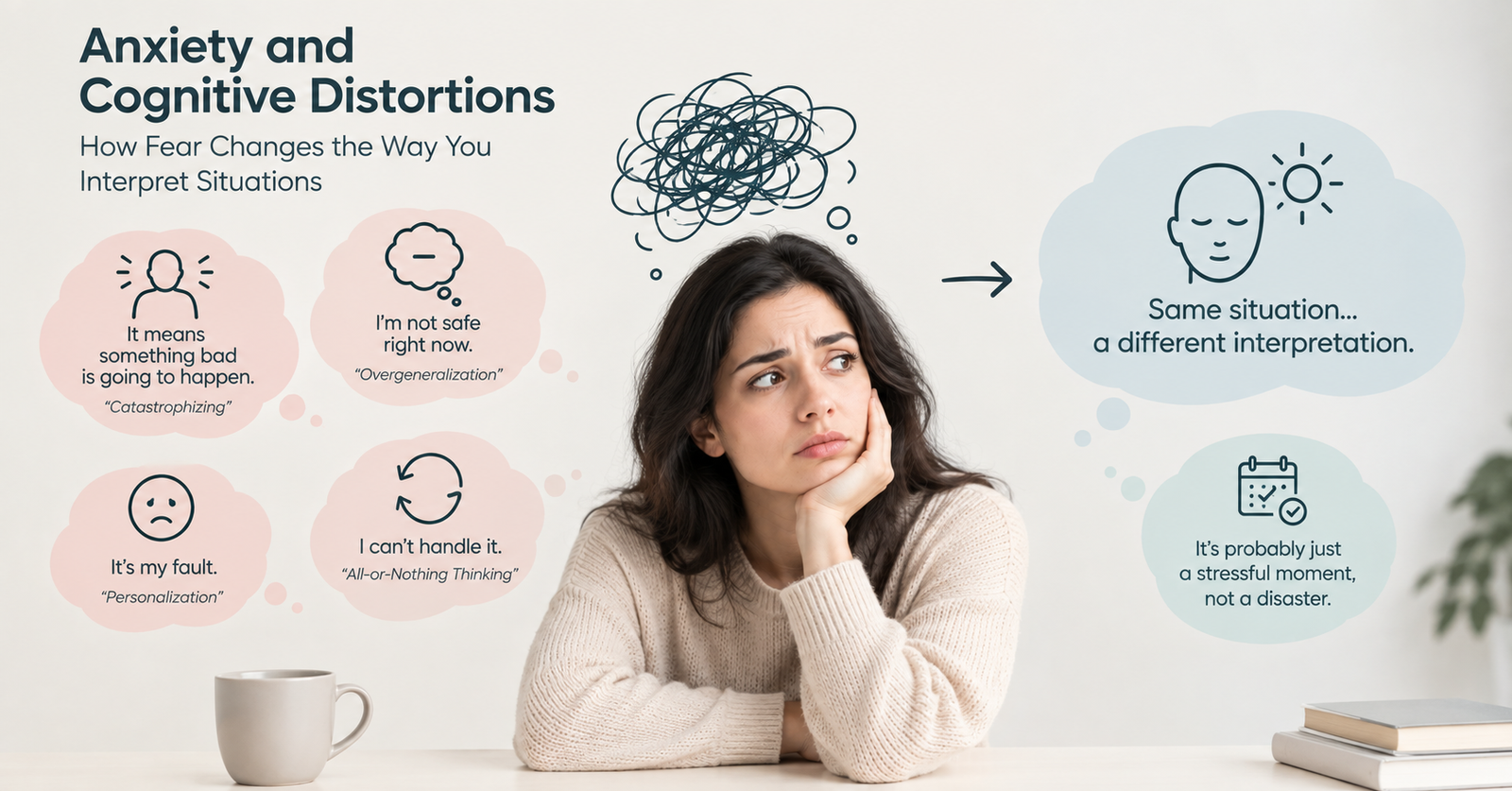
Anxiety can affect much more than your emotions. It can change how you interpret conversations, evaluate risks, remember experiences, and predict what might happen next.
A friend may take longer than usual to respond to a message, and your mind immediately assumes they are angry with you. Your manager may ask to speak with you, and you begin worrying that you have made a serious mistake. You may notice a normal physical sensation and immediately imagine the worst possible explanation.
The situation itself may be relatively neutral. What changes is the meaning your mind gives to it.
This is where anxiety and cognitive distortions can become closely connected.
Cognitive distortions are recurring patterns of thinking that can make situations appear more negative, dangerous, or certain than the available evidence suggests. Everyone experiences unhelpful thoughts occasionally, but they can become particularly troublesome when anxiety makes them frequent and difficult to challenge.
Research-based information about generalized anxiety disorder and cognitive behavioral therapy explains how automatic thoughts can influence emotions and behavior and how CBT can help people question inaccurate or harmful thought patterns. generalized anxiety disorder and cognitive behavioral therapy
What Are Cognitive Distortions?
Cognitive distortions are patterns of thinking that can cause you to interpret situations in an exaggerated, overly negative, or inaccurate way.
They usually aren’t deliberate.
A person doesn’t necessarily decide, “I’m going to think negatively about this.” Instead, the thought can appear automatically.
Imagine receiving a message from your manager:
“Can we talk tomorrow?”
There is no information about why they want to speak with you.
One person may think:
“It could be about something routine.”
Someone experiencing anxiety may immediately think:
“I must have done something wrong. I’m probably going to lose my job.”
The message is exactly the same.
The difference is the interpretation.
Anxiety can increase attention toward possible threats and contribute to biased interpretations of uncertain situations. Psychological research on anxiety describes processes such as increased attention to threat and a tendency to overestimate the risk associated with potentially threatening information. research on anxiety and threat interpretation
Why Does Anxiety Change the Way You Think?
Anxiety is closely connected with the body’s threat-response system.
When your brain detects potential danger, it becomes more alert. Your attention may become focused on identifying problems, avoiding mistakes, and preparing for negative outcomes.
That response can be useful when there is a genuine threat.
The problem occurs when the same process becomes activated by uncertainty, ordinary mistakes, social situations, or harmless physical sensations.
For example, uncertainty about an upcoming presentation might become:
“What if I make a mistake?”
Then:
“What if everyone notices?”
Then:
“What if they think I’m incompetent?”
Eventually:
“What if this ruins my career?”
The original situation hasn’t changed. But anxiety has progressively increased the perceived threat.
This can create a cycle:
Uncertainty → anxious interpretation → fear → increased attention to danger → more threatening thoughts → stronger anxiety
Over time, the cycle can become automatic.
Common Cognitive Distortions Associated With Anxiety
1. Catastrophizing
Catastrophizing means jumping from a relatively ordinary problem to the worst possible outcome.
For example:
- “I made one mistake, so I’ll lose my job.”
- “My friend didn’t answer, so they must be angry.”
- “I feel dizzy, so something serious must be happening.”
- “I failed this test, so I’ll never succeed.”
The problem isn’t considering possible risks.
The problem is treating the worst-case scenario as though it is the most likely scenario.
2. Fortune-Telling
Fortune-telling occurs when you predict a negative future without enough evidence.
You might think:
“I’m definitely going to embarrass myself.”
Or:
“This relationship is going to fail.”
Or:
“I’ll never be able to control my anxiety.”
Anxiety often dislikes uncertainty. Predicting a negative outcome can feel strangely reassuring because at least the mind has created an explanation for what might happen.
But a prediction isn’t a fact.
3. Mind Reading
Mind reading involves assuming you know what someone else is thinking.
For example, you walk into a room and two people stop talking.
Your anxious mind may immediately conclude:
“They were talking about me.”
But you don’t actually know that.
They could have been discussing work, a personal issue, another person, or something completely unrelated.
The anxious interpretation fills in missing information with the explanation that feels most threatening.
4. All-or-Nothing Thinking
All-or-nothing thinking divides situations into extremes.
You’re either successful or a failure.
Someone either likes you or hates you.
Your presentation is either perfect or terrible.
You either handled anxiety well or completely failed.
Real life usually contains much more middle ground.
You can make a mistake and still perform well overall.
You can have an uncomfortable conversation and still maintain a healthy relationship.
You can experience anxiety and still complete something successfully.
5. Overgeneralization
Overgeneralization occurs when one negative experience becomes a general rule.
For example:
“I had one bad relationship, so relationships never work.”
Or:
“I failed that interview, so I’ll never get a good job.”
One experience becomes evidence for an entire future.
This can make anxiety stronger because every new situation gets interpreted through the lens of the previous negative event.
6. Emotional Reasoning
Emotional reasoning happens when you treat a feeling as proof of reality.
For example:
“I feel unsafe, therefore I must be in danger.”
“I feel like everyone is judging me, therefore they must be judging me.”
“I feel like something bad will happen, so something bad must be coming.”
The feeling is real.
But the conclusion isn’t necessarily accurate.
Recognizing the difference between “I feel afraid” and “I am actually in danger” can be an important part of challenging anxious thinking.
7. Mental Filtering
Mental filtering occurs when you focus heavily on negative information while overlooking positive or neutral evidence.
Imagine receiving ten comments about your work.
Nine are positive.
One is critical.
You spend the entire evening thinking about the criticism.
Anxiety can make negative information feel especially important, causing one problem to overshadow everything that is going well.
This can gradually create the impression that your life is filled with problems even when the overall picture is much more balanced.
How Cognitive Distortions Affect Behavior
Anxious thoughts can influence what you do.
Consider someone who thinks:
“If I speak during the meeting, everyone will notice that I’m nervous.”
That thought creates anxiety.
The person stays silent.
They experience temporary relief.
But afterward, they may think:
“I knew I couldn’t handle it.”
The original belief becomes stronger.
The next meeting may produce even more anxiety.
This is one reason avoidance can maintain anxiety. Avoiding something can reduce discomfort temporarily, but it may also prevent you from discovering that the feared outcome wasn’t as likely as you expected.
Self-help CBT guidance describes how unhelpful thoughts can influence feelings and behavior and how avoidance can keep an anxiety cycle going. self-help CBT techniques for anxiety
Anxiety Can Also Change How You Interpret Physical Sensations
Cognitive distortions aren’t limited to social situations or work-related worries.
They can also involve physical sensations.
For example, someone may notice:
- A faster heartbeat
- Dizziness
- Sweating
- Shortness of breath
- Muscle tension
- A headache
- Stomach discomfort
An anxious interpretation might immediately be:
“Something is seriously wrong.”
But anxiety itself can produce physical symptoms. People with generalized anxiety disorder may experience symptoms including restlessness, difficulty concentrating, fatigue, muscle tension, headaches, stomachaches, sweating, trembling, and shortness of breath. physical symptoms associated with anxiety
This can create another feedback loop:
Physical sensation → frightening interpretation → increased anxiety → stronger physical sensation → more frightening interpretation
Learning to recognize this cycle doesn’t mean ignoring genuine medical symptoms. Persistent, severe, new, or concerning physical symptoms should still be evaluated by an appropriate healthcare professional.
How Can You Challenge Anxious Thoughts?
The goal isn’t to force yourself to think positively.
Instead, aim for more balanced and evidence-based thinking.
Ask yourself:
What evidence supports this thought?
Identify the actual facts rather than assumptions.
What evidence contradicts it?
Look for information that doesn’t support your feared conclusion.
Am I predicting the future?
Words such as always, never, definitely, everyone, nobody can sometimes signal overly extreme thinking.
Am I assuming what someone else thinks?
If you don’t have direct evidence, consider other possible explanations.
What is another possible interpretation?
Try generating two or three alternative explanations.
What would I tell a friend?
Imagine that someone you care about had exactly the same thought.
Would you tell them the worst outcome was guaranteed?
Probably not.
The purpose isn’t to convince yourself that everything will be perfect.
It’s to replace “This is definitely going to go badly” with something more accurate, such as:
“I don’t know what will happen yet, and there are several possible outcomes.”
Using Thought Records to Challenge Cognitive Distortions
One practical CBT technique is a thought record.
You write down:
- What happened?
- What did you feel?
- What automatic thought appeared?
- What evidence supports the thought?
- What evidence contradicts it?
- What is a more realistic interpretation?
- How do you feel after reconsidering the situation?
A structured thought record can help you identify the relationship between situations, thoughts, feelings, and behavior and practice developing more balanced interpretations. CBT thought record exercise
For example:
Situation: My friend hasn’t replied for six hours.
Automatic thought: “They’re angry with me.”
Evidence: They haven’t replied.
Evidence against: They often get busy and have taken hours to respond before.
Balanced thought: “I don’t know why they haven’t replied. There are several possible explanations.”
This doesn’t guarantee that anxiety disappears immediately.
It gives your brain another way to interpret the situation.
Can CBT Help With Anxiety and Cognitive Distortions?
Yes.
Cognitive behavioral therapy is one of the most established psychological treatments for anxiety disorders. It helps people identify automatic thoughts, understand how thoughts influence emotions and behavior, and develop more helpful responses.
Current clinical guidance describes CBT as a commonly used, research-supported treatment for generalized anxiety disorder. CBT treatment for anxiety disorders
CBT may also include behavioral strategies, exposure exercises, relaxation techniques, and other approaches depending on the person’s symptoms.
Research has also examined how CBT affects brain functioning in people with anxiety, adding to evidence about how psychological treatment can influence both symptoms and brain processes. research on CBT and anxiety symptoms
Can You Practice These Techniques Yourself?
Some CBT principles can be practiced independently, particularly when anxiety is mild.
You can start by noticing when a thought feels especially threatening and asking:
“Is this a fact, a prediction, or an assumption?”
You can also write down recurring anxious thoughts and look for patterns.
For example, do you frequently:
- Expect the worst?
- Assume people are judging you?
- Interpret uncertainty negatively?
- Focus on one mistake?
- Avoid situations because of feared outcomes?
- Treat feelings as proof?
- Repeatedly seek reassurance?
Recognizing your personal patterns is often the first step toward changing them.
However, self-help isn’t a substitute for professional treatment when anxiety is persistent or significantly affects daily life.
When Should You Seek Professional Help?
Occasional anxiety is normal.
It becomes more concerning when worry or fear is persistent, difficult to control, or interferes with everyday functioning.
Consider speaking with a healthcare or mental health professional if anxiety:
- Interferes with work or school
- Disrupts relationships
- Causes significant avoidance
- Makes concentration difficult
- Frequently affects sleep
- Produces persistent physical symptoms
- Causes overwhelming worry
- Makes ordinary activities increasingly difficult
Anxiety disorders involve more than occasional worry or fear; symptoms can persist across situations and interfere with daily life. information about anxiety disorders and when they become a disorder
Treatment may involve psychotherapy, medication, or both, depending on the individual’s symptoms and medical circumstances.
Frequently Asked Questions
What are cognitive distortions in anxiety?
Cognitive distortions are recurring patterns of thinking that can cause situations to be interpreted in exaggerated, overly negative, or threatening ways. Common examples include catastrophizing, mind reading, fortune-telling, emotional reasoning, and all-or-nothing thinking.
Can anxiety make you misinterpret situations?
Yes. Anxiety can increase attention toward potential threats and make negative interpretations feel more convincing, particularly when a situation is uncertain.
Why do anxious thoughts feel so real?
Anxious thoughts can trigger genuine emotional and physical reactions. Because the fear feels real, the brain may mistakenly interpret that feeling as evidence that the thought itself must be true.
Can cognitive behavioral therapy change anxious thinking?
CBT can teach people to recognize automatic thoughts, examine evidence, identify unhelpful thinking patterns, and develop more balanced interpretations. It is widely used for anxiety disorders. evidence-based CBT for anxiety
How can I stop catastrophic thinking?
Instead of trying to force the thought away, examine it. Ask what evidence supports the prediction, what evidence contradicts it, whether you’re confusing a possibility with a probability, and what other explanations exist.
Final Thoughts
Anxiety and cognitive distortions can create a powerful cycle in which fear changes the way you interpret everyday situations.
A delayed message can become rejection.
A small mistake can become failure.
Uncertainty can become danger.
A physical sensation can become a catastrophe.
The situation may not have changed.
Your interpretation of the situation has changed.
Learning to recognize cognitive distortions creates a small but important pause between an anxious thought and your response.
Instead of immediately asking:
“What if something terrible happens?”
try asking:
“What do I actually know, what am I assuming, and what other explanations are possible?”
The goal isn’t to convince yourself that everything will always be fine.
The goal is to develop a more balanced way of interpreting uncertainty, recognizing genuine risks without automatically turning every possibility into a threat.
For people whose anxiety is persistent or interferes with daily life, professional support can provide structured strategies for changing these patterns and managing anxiety more effectively.
Medical Disclaimer: This article is for educational purposes only and does not diagnose or treat anxiety disorders. If anxiety is persistent, severe, or interfering with daily activities, speak with a qualified healthcare or mental health professional.